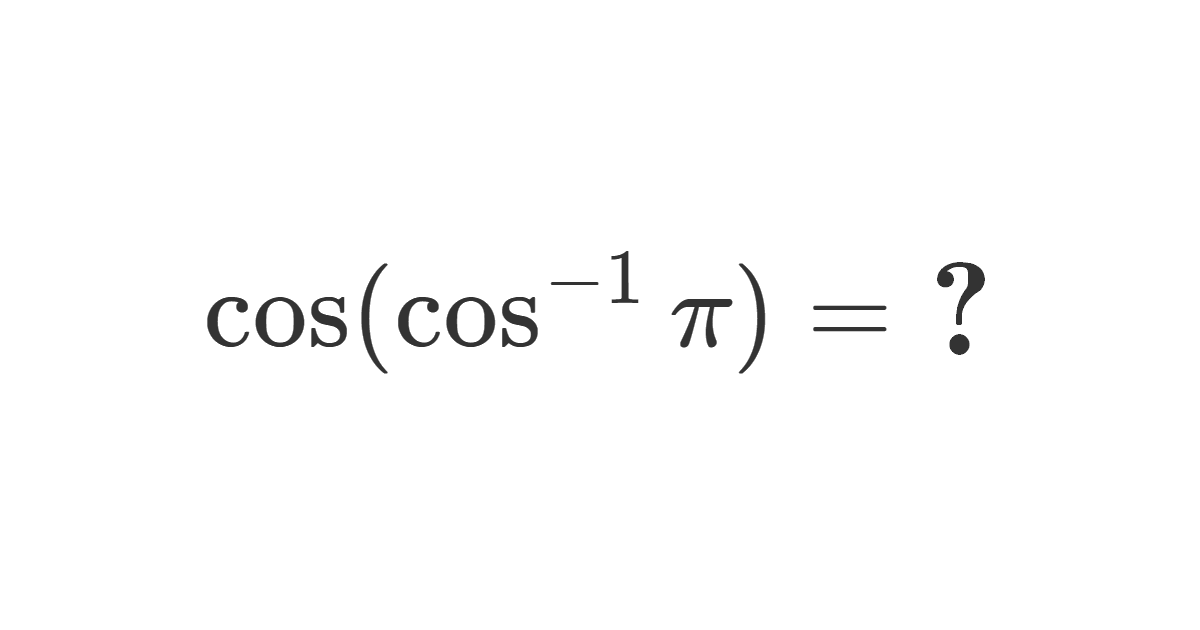
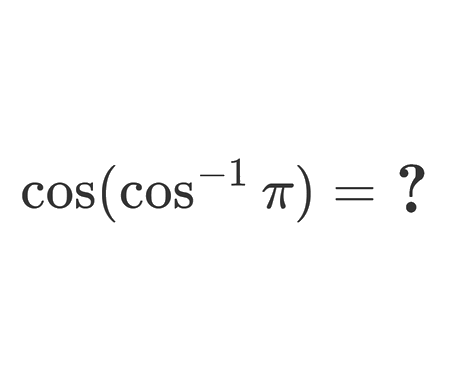
In this problem, we examine the expression \(\cos(\arccos(\pi))\). While \(\cos\) and \(\arccos\) are inverse functions, the arccosine (inverse cosine) is only defined for inputs in the interval \([-1, 1]\). Since \(\pi\) is approximately 3.14, well outside that domain, \(\arccos(\pi)\) is undefined in the real numbers. Let’s clarify why this happens and what the mathematical domain restrictions for \(\arccos\) are.
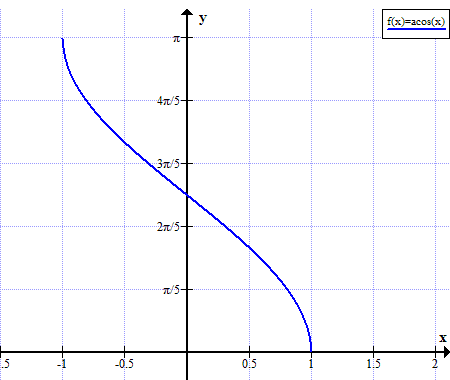
The arccosine of \(x\) is defined as the inverse cosine function of \(x\) when \(-1≤x≤1\):
\[\arccos x=\cos ^{-1} x\]
\(\pi \notin[-1,1]\) thus \(\cos ^{-1} \pi\) is undefined therefore \(\cos (\cos ^{-1} \pi)\) is undefined.
Because \(\pi\) is not in the domain \([-1, 1]\) of the \(\arccos\) function, \(\arccos(\pi)\) has no real value — and thus \(\cos(\arccos(\pi))\) is undefined in real arithmetic. This example underscores the importance of understanding domain restrictions for inverse trigonometric functions, particularly when dealing with values outside the allowed range. By keeping track of these limits, we can avoid common domain-related mistakes in trigonometry.